Appearing on Earth
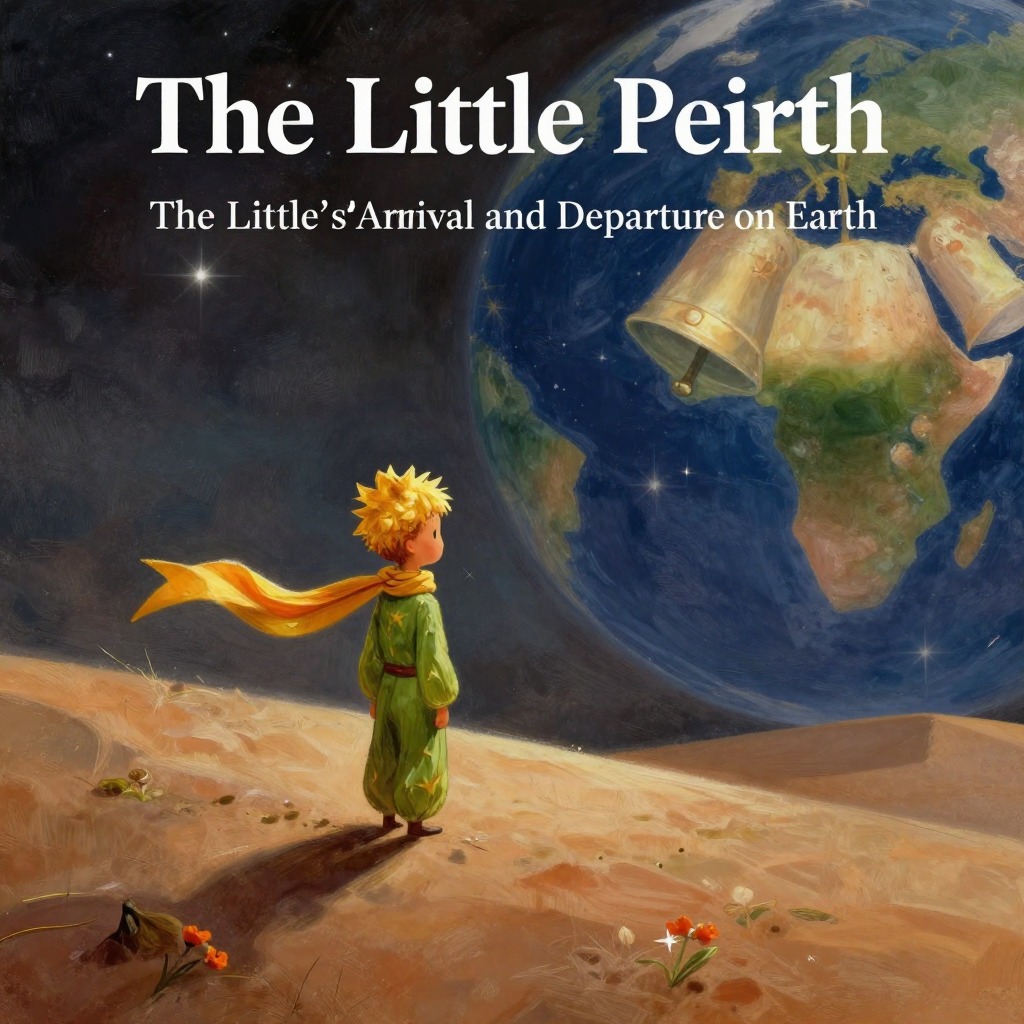
The Little Prince's appearance on Earth is the hinge on which the entire narrative turns. It is the moment he arrives in the African desert, the place the narrator calls "the loveliest and saddest landscape in the world," and it is also the place where he disappears. This double event—arrival and departure—frames the narrator's sorrow and gives rise to the story's central, unresolved question: whether the sheep has eaten the rose. The appearance is not merely a geographical fact but an emotional and philosophical rupture, one that transforms the narrator's universe and leaves him listening to the stars as if they were five hundred million little bells.
The Setting: The African Desert as Sacred Ground
The Little Prince appears on Earth in the African desert, a location the narrator deliberately redraws in the book to impress it on the reader's memory. He calls it "the loveliest and saddest landscape in the world," a phrase that fuses beauty with grief. The desert is not a random backdrop; it is the exact spot where the Little Prince materialized and later vanished. The narrator urges any future traveler who comes upon this place to wait "exactly under the star," suggesting that the site retains a cosmic significance, a point where the earthly and the celestial touch. The desert becomes a threshold between worlds, a sacred geography where the ordinary rules of time and space seem suspended.
The Arrival and Its Immediate Aftermath
The appearance itself is described with minimal detail—the Little Prince simply "appeared on Earth"—but its consequences are vast. The narrator, who had been stranded in the desert, encounters the Little Prince and is forever changed. Six years later, the narrator still has not told this story to anyone, and his companions were "well content to see me alive" when he returned, though he was sad and only said, "I am tired." The arrival initiates a bond so profound that the narrator's subsequent life is organized around the memory of the Little Prince. The appearance is thus not a single event but the beginning of a relationship that outlasts the physical presence of the boy.
The Disappearance and the Unfinished Business
The disappearance is as significant as the appearance. The narrator did not find the Little Prince's body at daybreak, which convinces him that the boy returned to his planet. Yet the departure is marred by an oversight: when the narrator drew the muzzle for the sheep, he forgot to add the leather strap. This small omission becomes a source of endless speculation. The narrator wonders what is happening on the Little Prince's planet—perhaps the sheep has eaten the flower. The disappearance is thus not a clean ending but the opening of a mystery that the narrator cannot resolve.
The Central Question: Has the Sheep Eaten the Rose?
The appearance on Earth sets in motion the story's central anxiety: the fate of the rose. The narrator oscillates between two possibilities. At one time he reassures himself that the Little Prince shuts his flower under her glass globe every night and watches over his sheep very carefully, and then he is happy, and there is sweetness in the laughter of all the stars. But at another time he imagines that the Little Prince was absent-minded, that on some evening he forgot the glass globe, or the sheep got out without making any noise in the night, and then the little bells are changed to tears. This uncertainty is described as "a great mystery," one that affects the entire universe: "nothing in the universe can be the same if somewhere, we do not know where, a sheep that we never saw has—yes or no?—eaten a rose." The narrator insists that no grown-up will ever understand that this is a matter of so much importance.
The Narrative Role and the Reader's Invitation
The appearance on Earth is not just a plot point; it is a narrative device that draws the reader into the mystery. The narrator directly addresses the reader, asking them to look up at the sky and ask themselves whether the sheep has eaten the flower, promising that "you will see how everything changes." He also describes the signs by which one might recognize the Little Prince if he returns: a little man who laughs, has golden hair, and refuses to answer questions. The narrator pleads with any traveler who encounters him to send word that he has come back. This invitation transforms the reader from a passive observer into a participant in the search, making the appearance on Earth a call to vigilance and hope. The event thus carries the weight of the book's entire emotional and philosophical project: the insistence that love, loss, and the fate of a single rose are matters of cosmic importance, and that the Little Prince's brief time on Earth is a gift that must be remembered and awaited.